
Promoting Quitting
Quitting commercial tobacco and nicotine products is difficult because they rapidly deliver addictive nicotine to the brain (CDC, 2024d, 2024g). Regular use leads to dependence, and quitting often leads to withdrawal. Use of these products can also become part of a person’s daily routine, making it even harder to stop.
The SUTPP has the goal of reducing the health burdens of commercial tobacco and nicotine use by promoting and supporting quitting among adults and youth.
In this section, WYSAC explores the desire to quit among adults who currently use commercial tobacco and their quit attempts. WYSAC looks at awareness of quitlines, use of quit aids, and barriers to quitting. This section also covers visits to healthcare providers and conclusions and recommendations based on the data and best practices in helping people quit.
Efforts to Quit Smoking
Desire to Quit Among Adults Who Smoke
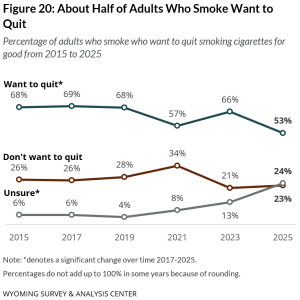
About half (53%) of adults who currently smoke want to quit smoking cigarettes. This was a significant decrease from 68% in 2015. The 13 percentage-point difference between 2023 and 2025 was not significant. About one in four adults who currently smoke were unsure about whether they want to quit smoking cigarettes. This was a significant increase from 6% in 2015 (Figure 20).
Quit Attempts Among Adults Who Smoke
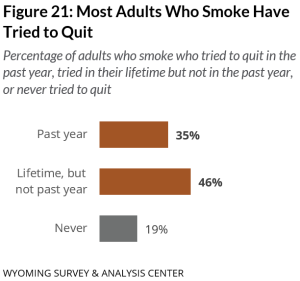
At some point in their lives, the majority (81%) of adults who currently smoke had stopped smoking for at least one day because they were trying to quit for good.
About one in three (35%) adults who currently smoke have tried to quit smoking at least once in the past year because they were trying to quit for good (Figure 21).
Smokers’ quit attempts have not changed significantly between 2010 and 2025.
Aids to Quit Smoking
Awareness of Quitlines
Most (69%) adults who use commercial tobacco or nicotine (including ENDS) were aware of telephone quitline services (Figure 22). About two in five (43%) adults who do not use commercial tobacco or nicotine were aware of telephone quitline services.
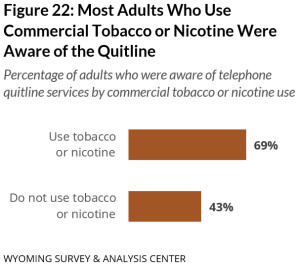
This may demonstrate the success of media campaigns by SUTPP and their partners, including county-level efforts.
Obstacles to Quitting Cigarettes Among Adults Who Smoke
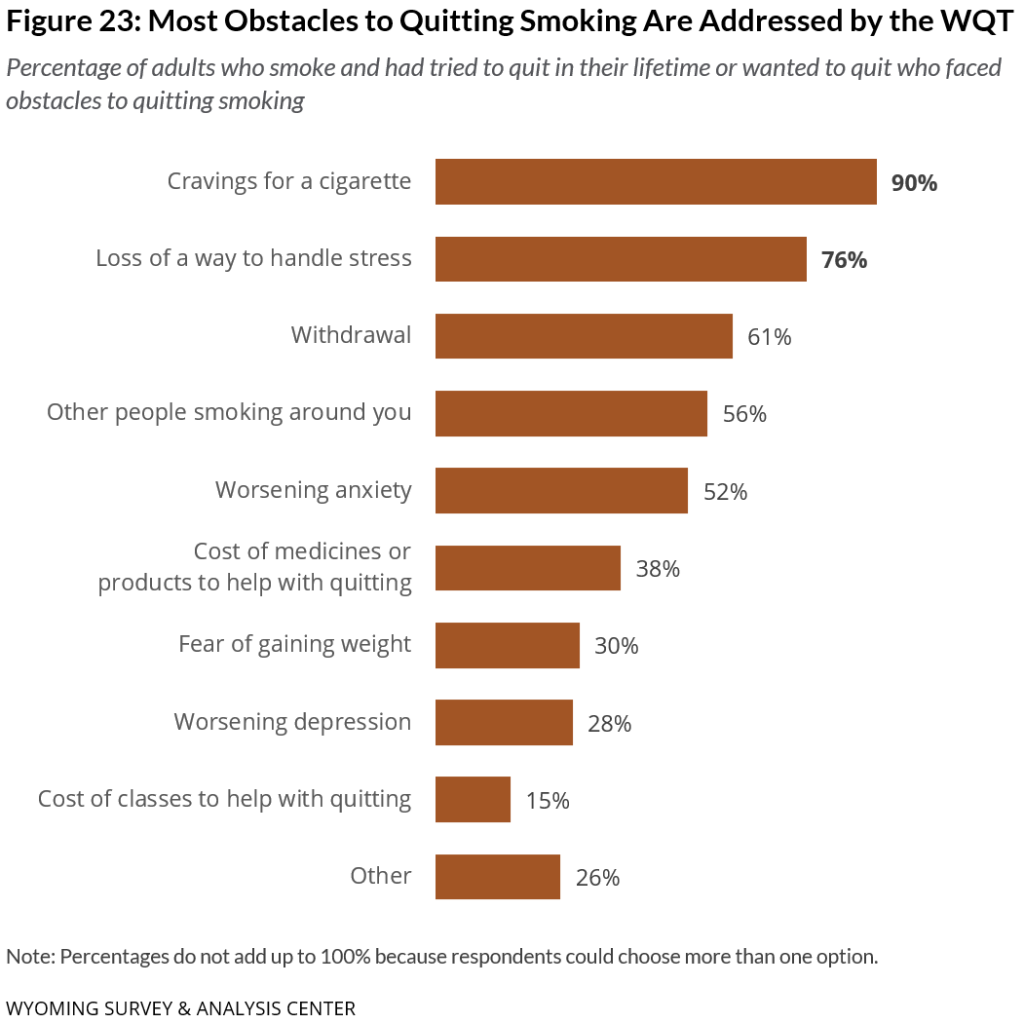
Cravings for a cigarette were the most common obstacle for adults who smoke and tried to quit in their lifetime or wanted to quit (90%; Figure 23). The second most common obstacle to quitting cigarettes was the loss of a way to handle stress (76%). The Wyoming Quit Tobacco (WQT) program specifically targets the most common obstacles to quitting smoking (https://www.quitwyo.org). In particular, the medications provided are designed to reduce cravings. Coaching can include strategies to deal with other obstacles, such as losing a way to handle stress.
In addition, 56% reported that other people smoking around them is an obstacle to quitting smoking. These adults could benefit from increased smokefree air policies in their environments.
Quitting ENDS Use
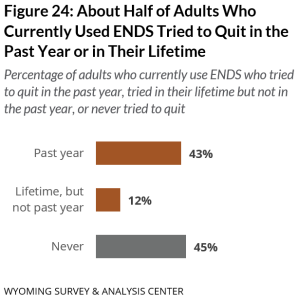
In 2025, about half (55%) of adults who currently used ENDS had tried to quit in the past year or in their lifetime (Figure 24).
Health Professionals’ Involvement in Quitting Commercial Tobacco or Nicotine Use
Visits with Health Professionals
The 2025 Wyoming Adult Commercial Tobacco and Nicotine Survey asked respondents if they had seen a health professional (a doctor, dentist, nurse, or another health professional) in the past year and, if so, if the health professional asked if they smoked cigarettes or used any other commercial tobacco or nicotine products, including ENDS.
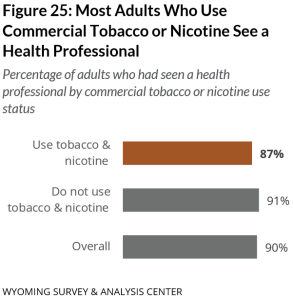
In 2025, 25% of adults used commercial tobacco or nicotine (including those who smoked in the past year). Most of these adults had seen a health professional in the past year (87%; Figure 25). Those who did not see a health professional (13%) missed an opportunity to discuss tobacco and nicotine use and quitting with their provider, a key intervention point. Commercial tobacco or nicotine use was not related to the likelihood of seeing a health professional.
Patient Experiences with Health Professionals’ Support for Quitting Commercial Tobacco and Nicotine Use
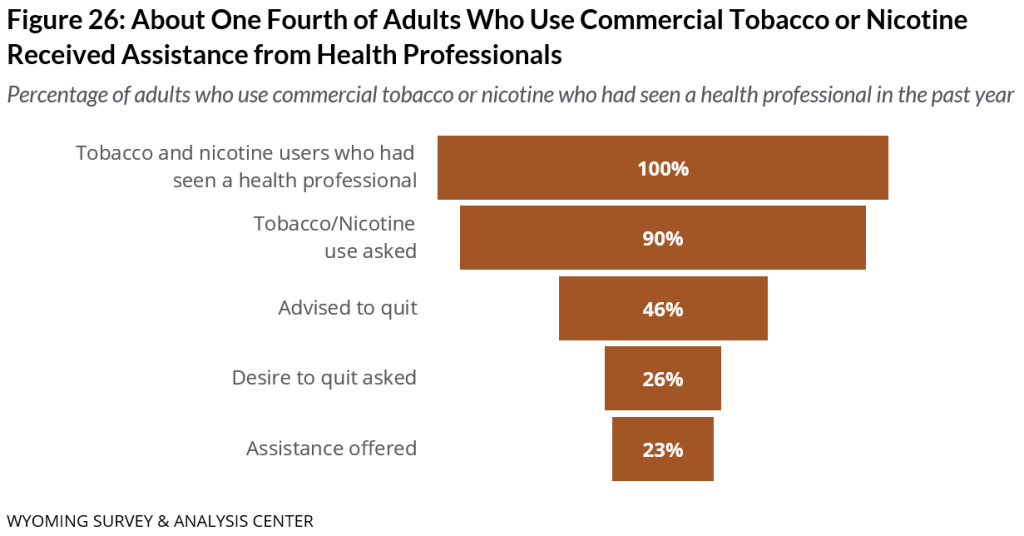
Adults are often asked about their commercial tobacco or nicotine use when visiting a health professional. In 2025, 78% of all adults were asked if they smoked cigarettes or used any other commercial tobacco or nicotine products. Adults who used commercial tobacco or nicotine (90%) were more likely to be asked if they smoked cigarettes or used any other commercial tobacco or nicotine products than adults who did not use commercial tobacco or nicotine (73%).
WYSAC does not know to what extent health professionals use medical records to screen for commercial tobacco or nicotine use during a visit. This may have been a limitation when health professionals did not ask about commercial tobacco or nicotine use because they already had records of it.
About a quarter (23%) of commercial tobacco or nicotine users were offered assistance with quitting, even when focusing on those who say a professional asked them about their commercial tobacco or nicotine use (Figure 26).
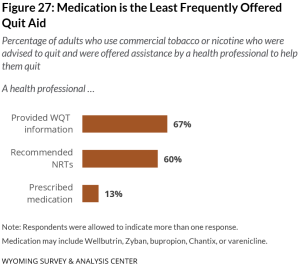
When adults who use commercial tobacco or nicotine were offered assistance, health professionals provided WQT information (67%; Figure 27), recommended nicotine replacement therapies (NRTs) (60%), and prescribed medication (13%). The percentage of adults who received WQT information significantly decreased from 87% in 2021 to 67% in 2025. The percentage of adults who were prescribed medication also significantly decreased from 39% in 2021 to 13% in 2025. Healthcare providers offering support such as NRT, prescription medication, and referral to quitline services such as WQT align with best practices for support of quitting. Opportunities exist to increase the number of adults who are offered assistance by their healthcare provider to quit.
Conclusion
Most smokers want to quit smoking cigarettes or have tried to quit at some point in their lives. When they try to quit or want to quit, adults who use commercial tobacco or nicotine face obstacles such as cravings for a cigarette, loss of a way to handle stress, and others smoking around them. The WQT program is designed to assist with all of these obstacles.
Most adults who use commercial tobacco or nicotine are aware of quitline services.
Education and media emphasizing how the WQT program addresses common barriers to quitting smoking may increase enrollment in the WQT program. Additionally, the use of WQT program offerings (such as NRT and medications) can then increase the chances of adults quitting.
Many adults who currently use ENDS want to quit. Among adults who currently use ENDS, about half had tried to quit ENDS in the past year or in their lifetime.
 Visits to health professionals are opportunities for connecting current commercial tobacco or nicotine users to available resources and addressing barriers to quitting. Most adults were asked by a health professional if they used commercial tobacco or nicotine products. Adults who use commercial tobacco or nicotine were less likely to report that health professionals followed up or offered help with quitting than they were to report being asked about their use. Greater collaboration with health professionals could result in more commercial tobacco or nicotine users becoming aware of, and receiving, services that could increase their chances of quitting (CDC, 2015a).