
Electronic Nicotine Delivery Systems (ENDS)
2025 ENDS Use in Wyoming
In previous iterations of the Wyoming Adult Commercial Tobacco and Nicotine Survey, ENDS use has been more common among young adults than among other adults. A limitation of the survey is the difficulty of getting young adults to respond. With a small subset of the respondents being young adults, reporting on the total adult population is necessary. That may hide some key findings that would be clearer in a survey of only young adults.
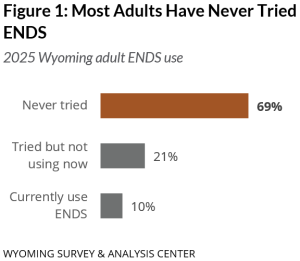
Most Wyoming adults (69%) have never tried ENDS, and few are current ENDS users (10%; Figure 1). For this report, current ENDS users are the respondents who said they use ENDS every day or some days.
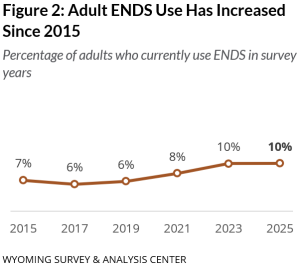
However, current ENDS use has increased significantly from 7% in 2015 to 10% in 2025. ENDS use is now matching the cigarette smoking rate (10% in 2025; Figure 2).
Flavored ENDS Use
In 2025, the use of flavored ENDS was common for Wyoming adults:
- 93% of adults who currently use ENDS had used products flavored to taste like mint, candy, fruit, chocolate, or other flavors besides tobacco in the past 30 days.
- 33% of adults who currently use ENDS had used products flavored to taste like menthol in the past 30 days.
- 47% of adults who had tried ENDS in their lifetime did so for the flavoring.
Wyoming adults’ use of flavored ENDS products has not significantly changed between 2017 and 2025, despite regulations implemented by the FDA in 2020 that partially banned ENDS flavors except menthol and tobacco. However, the ban has loopholes. It only applies to cartridge-style ENDS devices, like JUUL. These products have closed, pre-filled e-liquid cartridges that the user replaces when empty. The ban does not include ENDS with refillable e-liquid tanks or single-use or disposable products, like Juice Head. According to the FDA, these exceptions avoided restricting all flavor options for adults who may be using ENDS to stop smoking (FDA, 2020). However, research shows that youth and young adults are using menthol instead of mint and are switching to the types of ENDS that can still have flavors (Truth Initiative, 2020).
Reasons for Trying ENDS
For adults, the top three reasons for trying ENDS were for the flavoring (63%), to quit smoking cigarettes (59%), and to not disturb other people with smoke (56%; Figure 3). The pattern of these results has not changed significantly since these questions were first asked in 2015, except the “for the flavoring” response, which was added in 2017.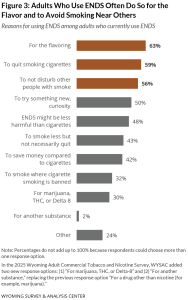
However, comparisons using data between 2015 and 2025 may indicate some emerging trends among adults who currently use ENDS. There was a significant decrease in trying ENDS because they think ENDS might be less harmful than cigarettes, from 64% in 2015 to 48% in 2025.
Some research suggests that use of ENDS with nicotine is associated with quitting smoking. The CDC has said that adults who smoke may see benefits from completely switching from smoking to ENDS (CDC, 2024e). However, there is not enough evidence to be sure (CDC, 2020, 2024e). More research is needed to learn if ENDS are a broadly successful tobacco-related harm reduction tool. The FDA has not approved ENDS as a cessation aid (CDC, 2024e).
Do People Think ENDS Use Is Harmful?
The survey includes a question regarding how harmful people think ENDS use is to one’s health. Perceived harmfulness of ENDS has significantly increased since 2017, with most adults saying it is very harmful (72%; Figure 4).
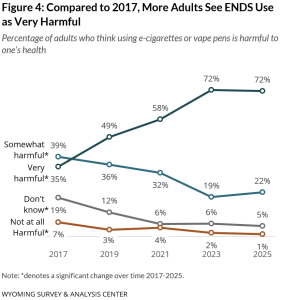
One reason for this change may be that the public health community, including the SUTPP and county partners, sponsored media messaging about the harms of ENDS use after 2017.
This increased perception of harm may also be a factor in fewer adults trying ENDS because they think ENDS might be less harmful than cigarettes (see Reasons for Trying ENDS).
Starting ENDS Use
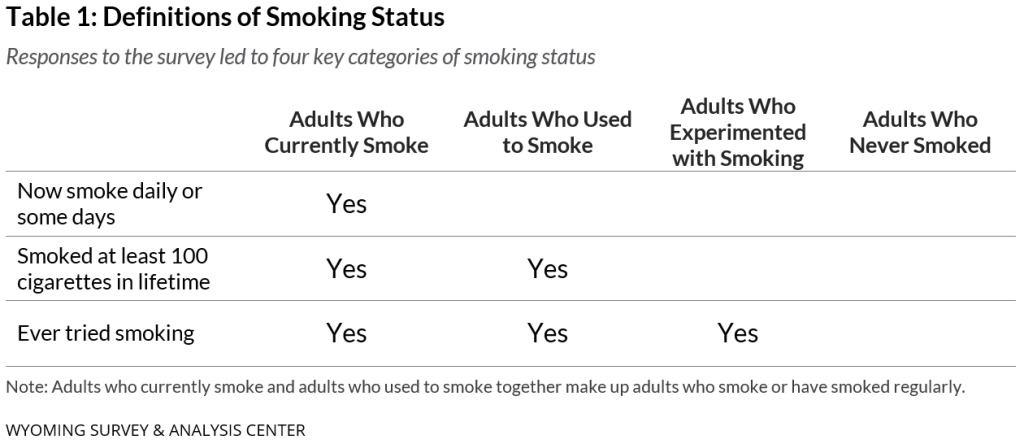
Findings about first using cigarettes or ENDS are somewhat limited because many people in the Wyoming Adult Commercial Tobacco and Nicotine Survey sample would have started using commercial tobacco or nicotine before ENDS became commonly used in the US (roughly 2012). Adults who had ever tried smoking (see Table 1 for a summary of the four smoking status categories) and had also tried ENDS were asked whether they used cigarettes or ENDS first. In 2025, 17% of adults who currently smoke and had also tried ENDS used ENDS first, with no significant change from 2017 to 2025. Similarly, 13% of adults who used to smoke and had also tried ENDS used ENDS first, also with no significant change. Among adults who experimented with smoking and had also tried ENDS, those who used ENDS first increased significantly from 18% in 2017 to 41% in 2019 and remained relatively stable from 2019 to 2025 (37%).
Eliminating Secondhand Exposure
Exposure to Secondhand ENDS Aerosol in Public Places
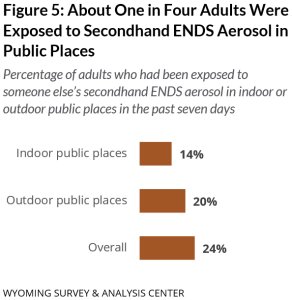
About one in four (24%) adults were exposed to secondhand aerosol from ENDS use in public places, indoors or outdoors (Figure 5). Fewer (14%) adults reported breathing someone else’s secondhand aerosol in indoor public places. One in five (20%) adults were exposed to secondhand aerosol in outdoor public places. These may be underestimates if the short-lived cloud or smell from secondhand aerosol is not noticed.
Opinions About the Harms of Secondhand ENDS Aerosol
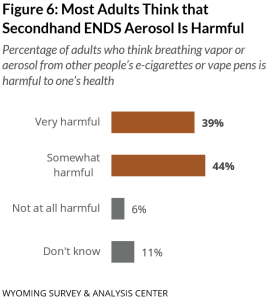
In 2025, most (83%) adults thought that breathing someone else’s secondhand aerosol was very or somewhat harmful (Figure 6). Consistent with a lack of firm research findings, a few (11%) said they were unsure about the harmfulness of secondhand aerosol.
Conclusion
These findings reflect the total adult population of Wyoming. Surveys focused on young adults or youth may find different patterns.
Current ENDS use among adults has increased since 2015, now matching the cigarette smoking rate (10% in 2025).
Many adults who currently use ENDS tried ENDS for the flavor, to not disturb other people with smoke, or to quit smoking cigarettes. Current research (CDC, 2020, 2024e) does not show a consistent benefit of using ENDS to quit smoking. The FDA has not approved ENDS as a cessation aid (CDC, 2024e).
The perceived harm of ENDS has grown over time. Compared to 2017, more Wyoming adults said vaping is harmful.