Eliminating Exposure to Secondhand Smoke for People Who Do Not Smoke
Support for Smokefree Indoor Air Policies at Restaurants, Workplaces, Casinos and Clubs, and Bars
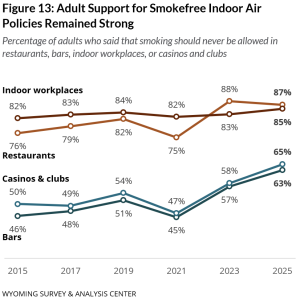
The Wyoming Adult Commercial Tobacco and Nicotine Survey questions about smokefree indoor air policies asked adults if they think smoking should be allowed indoors at workplaces, restaurants, bars, and casinos and clubs. Casinos and clubs were combined in one item on the survey, so WYSAC treated them as a single venue type.
In 2025, most adults (87%; Figure 13) supported smokefree indoor air policies for restaurants. Most (85%) adults supported smokefree indoor air policies for workplaces. More than half (65%) of adults supported smokefree indoor air policies for casinos and clubs. More than half (63%) of adults supported smokefree indoor air policies for bars.
Support for smokefree indoor workplaces has remained stable since 2015. Support for smokefree indoor air policies for restaurants, casinos and clubs, and bars significantly increased between 2015 and 2025. For casinos and clubs, the increase in support from 2023 to 2025 was also significant.
Support for Other Smokefree Air Policies
Commercial Tobacco-Free School Policies
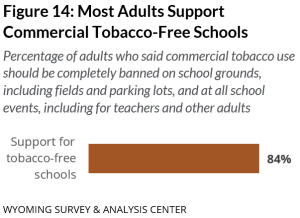
In 2025, most adults (84%; Figure 14) thought that commercial tobacco should be completely banned at schools. This high level of support has been consistent since 2010.
Smokefree Park Policies
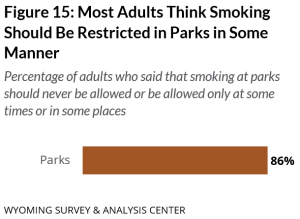
In 2025, the majority of Wyoming adults (86%) thought smoking should be restricted at outdoor parks, at least in some manner. This is a significant increase from 82% in 2015. About two in five (43%; Figure 15) adults thought that smoking should never be allowed, significantly higher than in 2023. Meanwhile, another two in five (43%) thought that smoking should be allowed only at some times or in some places, which was significantly lower than in 2023.
Smokefree Outdoor Workplace Policies
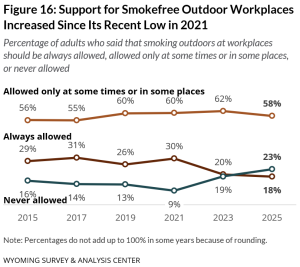
Support for policies making outdoor workplaces smokefree was substantially lower than support for policies making indoor workplaces smokefree. In 2025, only 23% (Figure 16) of adults supported a smokefree air policy for outdoor workplaces, compared to 85% for indoor workplaces. However, support for such a policy has increased significantly since its recent low of 9% in 2021.
Exposure to Secondhand Smoke
Smoking Policies at Work
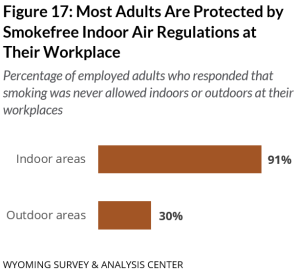
In 2025, most employed adults (91%; Figure 17) reported that smoking was never allowed in indoor areas (including inside a vehicle) at their place of work. This is a significant increase from 87% in 2019.
About one in three (30%; Figure 17) adults reported that smoking was not allowed in outdoor areas. This has significantly increased since 2012 (25%). Workers are better protected by smoking regulations indoors than outdoors.
Exposure to Secondhand Smoke at Work and in Public Places
In 2025, most employed adults (81%) were not exposed to secondhand smoke at their workplace. Still, 19% of employed adults reported experiencing secondhand smoke indoors or outdoors at their workplace. There has been no significant change between 2015 and 2025.
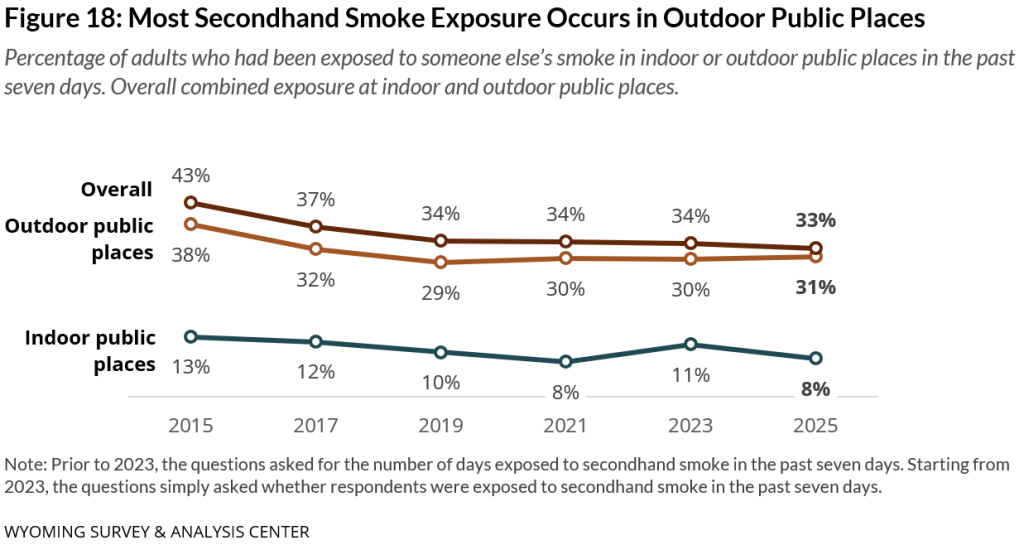
In 2025, about one in three adults (33%; Figure 18) reported breathing someone else’s secondhand smoke in public places, indoors or outdoors. Most adults (67%) were not exposed to secondhand smoke. Almost one in three adults (31%) reported exposure to secondhand smoke in outdoor public places. Fewer adults (8%) reported exposure to secondhand smoke in indoor public places. Although still a cause for concern, exposure to secondhand smoke has significantly decreased in public places, indoors or outdoors, between 2015 and 2025.
In 2025, the chances of being exposed to secondhand smoke while in a public place were not significantly different between adults who currently smoke and those who do not smoke:
- 36% of adults who currently smoke reported exposure to secondhand smoke
- 32% of adults who do not smoke reported exposure to secondhand smoke
Opinions About the Harms of Secondhand Smoke
Over the years, nearly all adults have thought that exposure to secondhand smoke is harmful to one’s health. In 2025, 97% (Figure 19) believed secondhand smoke was very or somewhat harmful to one’s health. Only 3% believed that it was not harmful. These perceptions of harm have not changed significantly between 2015 and 2025.
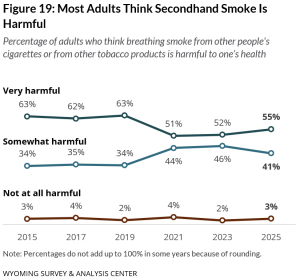
However, opinions about the harmfulness of secondhand smoke have shifted in recent years. Adults who think breathing secondhand smoke is very harmful significantly decreased between 2019 and 2025.
Conclusion
 Over the years, exposure to secondhand smoke has significantly decreased in public places, indoors or outdoors. Two in three adults reported not being exposed to secondhand smoke in public places, indoors or outdoors.
Adults have consistently and strongly supported smokefree indoor air policies for workplaces and restaurants. In addition, support for smokefree indoor air policies for casinos and clubs and bars has increased. Wyoming adults continue to support a complete ban on commercial tobacco use at schools. Most adults thought that smoking should be restricted at parks, at least in some manner. Most employed adults are not exposed to secondhand smoke at work, indoors or outdoors.
Wyoming still has room for improvement. Smoking policies in outdoor areas, including at work and in public places, are less protective of adults. Adult support for outdoor policies at work and indoor air policies at adult-oriented establishments has increased. Wyoming may benefit from focusing on prevention efforts in these areas. Recent decreases in reports of seeing secondhand smoke as “very harmful” may indicate a need for revisiting education about the harms of secondhand smoke.