
Cigarette Smoking and Use of Other Commercial Tobacco and Nicotine Products
Cigarette Smoking in 2025
Wyoming Adult Commercial Tobacco and Nicotine Survey responses were divided into four key categories of smoking status, described in Table 2.
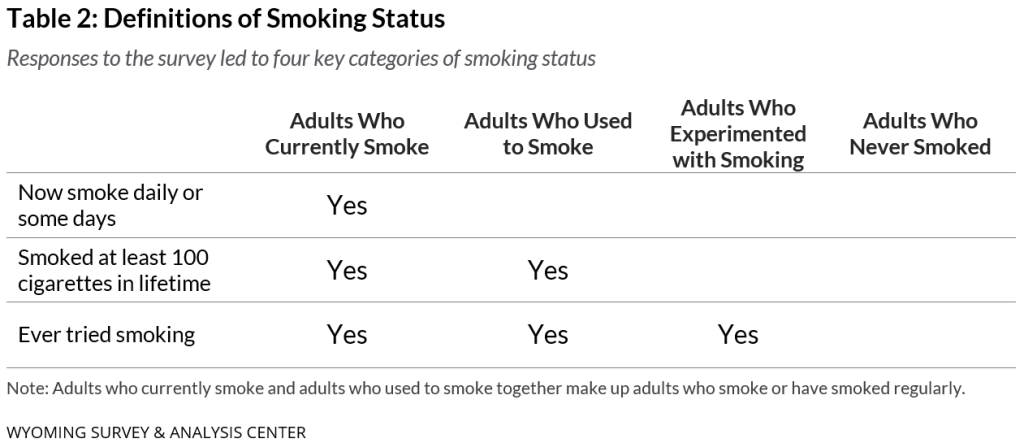
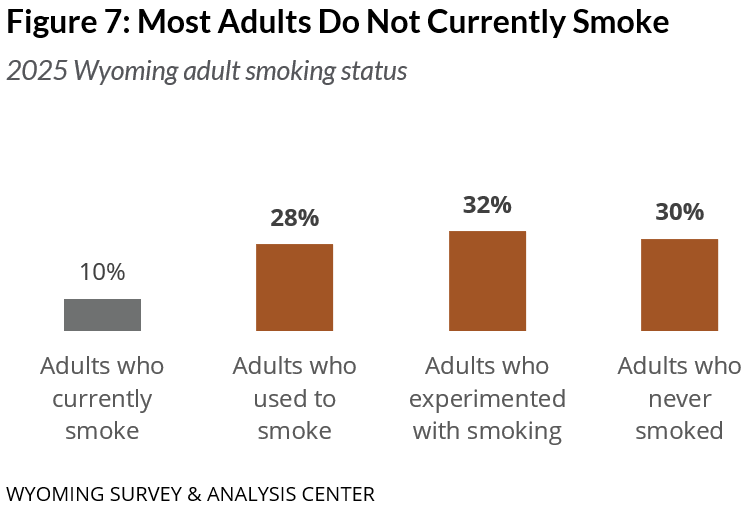
Most (90%) adults do not currently smoke, and nearly two in three (62%) adults have never smoked regularly. That is, they have not smoked at least 100 cigarettes in their lifetime. About one in three (30%) adults had never tried smoking or (32%) had experimented with smoking and nearly one in three (28%) used to smoke (Figure 7). Although current cigarette smoking has decreased from 21% in 2006 to 10% in 2025, one in 10 Wyoming adults currently smoke.
Do People Think Smoking Cigarettes Is Harmful?
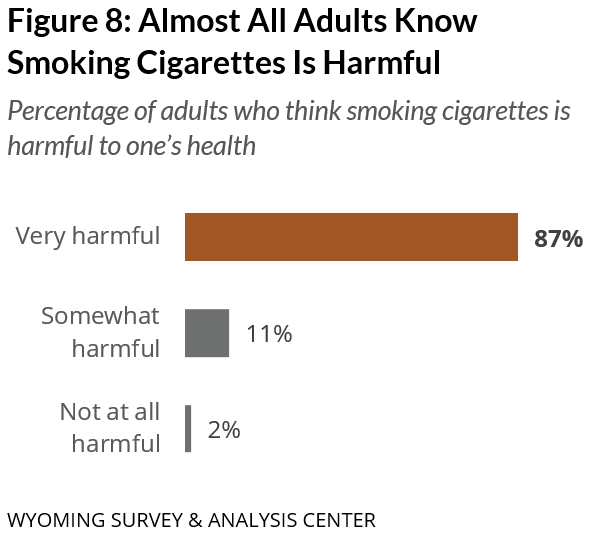
About sixty years ago (January 11, 1964), the U.S. Surgeon General first released an official report documenting links between smoking and two diseases: cancer and chronic bronchitis (U.S. Department of Health, Education, and Welfare, 1964). Since then, the list of smoking-related diseases has grown dramatically (USDHHS, 2014). Additionally, SUTPP, CDC, county, and other public health efforts have worked to educate the public about the potential harms of commercial tobacco use. Key components of these education efforts include warning labels on packaging and advertising, sharing research findings, and sharing educational content in various forms from print to social media (CDC, 2024a; USDHHS, 2014). These efforts have succeeded in Wyoming; in 2025, only 2% of adults said smoking was “not at all harmful” (Figure 8).
Other Commercial Tobacco and Nicotine Products (Including ENDS)
In 2025, about one in four (24%) Wyoming adults use one or more types of commercial tobacco and nicotine products. These include cigarettes, smokeless tobacco, cigars, pipes, hookah, ENDS, and new and emerging products such as heated tobacco, nicotine pouches, dissolvable nicotine, nicotine gels, and any other types. This overall rate has remained relatively stable since questions about new and emerging products were first asked in 2021, when 28% of adults reported using these products.
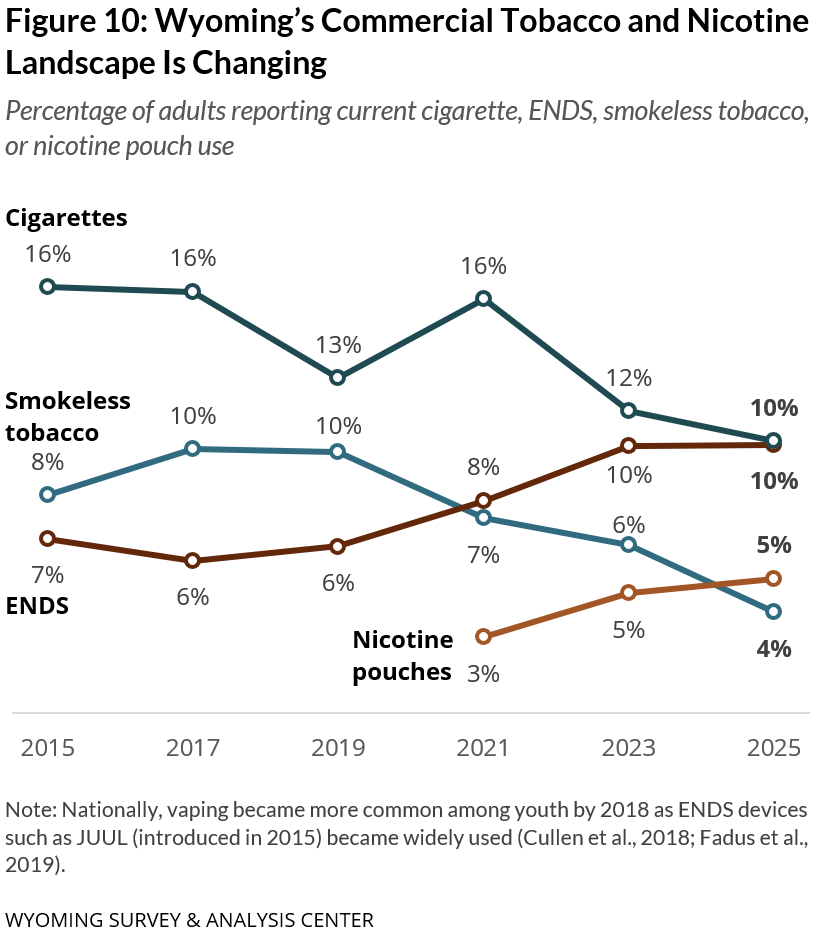
Among the 24% of Wyoming adults who use some form of commercial tobacco or nicotine, cigarettes, ENDS, and nicotine pouches were the most commonly used commercial tobacco and nicotine products among Wyoming adults. Cigarettes was the most used product throughout the history of the Wyoming Adult Commercial Tobacco and Nicotine Survey until ENDS use matched smoking in 2025 (Figure 9).
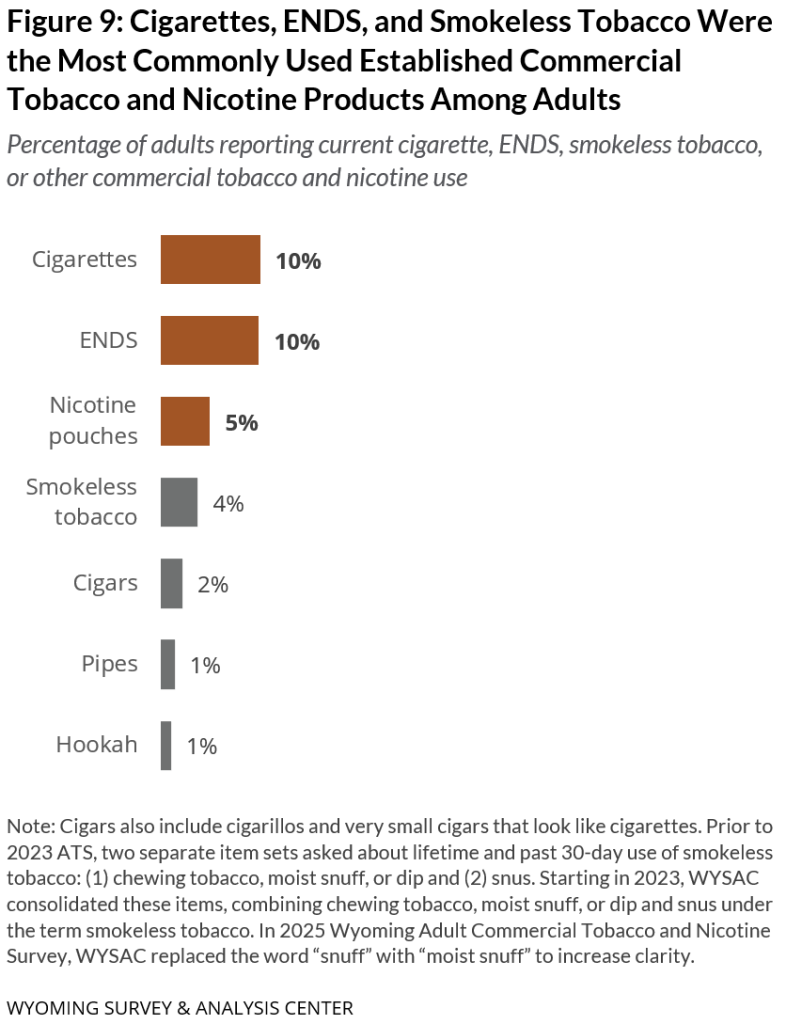
From 2015 to 2025, current ENDS use increased from 7% to 10% and is now at the same level as cigarette use. The use of cigars and smokeless tobacco has significantly decreased since 2010, while the use of regular pipes and hookah have remained consistent.
The use of new and emerging commercial tobacco and nicotine products remains lower among adults. The most common of these emerging products was nicotine pouches, such as ZYN or on!; 5% of adults used these products. The use of nicotine pouches among Wyoming adults has significantly increased from 3% in 2021 to 5% in 2025, making the use of nicotine pouches comparable to smokeless tobacco. Surveys specific to youth or young adults, who might be more likely to try new and emerging products, have shown similar increases with one survey showing an increase in reported nicotine pouch use of nearly 4 times between 2022 and 2023 among youth and young adults in the U.S. (CDC Foundation, 2025).
Wyoming’s commercial tobacco and nicotine landscape is changing (Figure 10). Cigarette smoking has fallen, vaping is now just as common as smoking, and nicotine pouches are emerging as a newer product being used at a similar rate as smokeless tobacco.
Conclusion
 The public is very aware that smoking is harmful. Only 2% of adults said that smoking is not at all harmful.
The adult smoking rate, as measured by the Wyoming Adult Commercial Tobacco and Nicotine Survey, has decreased significantly to 10% compared to 21% in 2006. Since 2010, the use of other commercial tobacco and nicotine products has remained fairly consistent or decreased, except for ENDS and nicotine pouches. ENDS use is now at the same level as cigarette use, and nicotine pouch use is about the same level as smokeless tobacco use.
Cigarettes, ENDS, and nicotine pouches were the three most commonly used commercial tobacco and nicotine products among adults. ENDS and nicotine pouches are a subject of concern for youth and young adults because of national trends showing increased use (Gentzke et al., 2022; CDC Foundation, 2025) and the potential for them to lead to cigarette smoking (Berry et al., 2019; Hair et al., 2021). Their relative use rate is also increasing.
There is developing evidence that newer commercial tobacco and nicotine products (such as nicotine pouches) may become more commonly used than more established types (such as smokeless tobacco, hookah, or cigars).